
Fentanyl Decontamination in San Francisco
San Francisco is at the center of the United States' illicit fentanyl crisis. The Tenderloin neighborhood and 6th Street corridor have among the highest rates of outdoor drug use and overdose deaths of any urban area in the country. Illicitly manufactured fentanyl (IMF) — including fentanyl analogs like carfentanil — now dominates the city's drug supply, and it leaves behind contamination wherever it is present, used, or stored.
Unlike most hazardous substances, fentanyl contamination is invisible and odorless. A room that looks and smells clean may carry surface concentrations capable of causing exposure. Property managers, landlords, families, and hotel operators who discover evidence of fentanyl use in their properties face a remediation challenge that requires specialized testing, protocols, and post-cleanup verification — not standard janitorial service.
Why Fentanyl Is Different From Other Drug Residue
Methamphetamine cleanup is well-established, with regulatory frameworks in many states. Fentanyl is categorically different in its potency, its exposure routes, and the lack of widely adopted clearance standards — which makes professional assessment more important, not less.
Microgram-Level Activity
Fentanyl is roughly 100× more potent than morphine and 50× more potent than heroin by weight. A quantity too small to see with the naked eye can produce pharmacological effects. This means routine visual inspection of a surface gives no reliable indication of whether dangerous residue is present.
Dermal Absorption
Fentanyl is specifically formulated in medical contexts for transdermal delivery — meaning it passes through intact skin. Surface contact without gloves at a contaminated site carries a real absorption risk. NIOSH recommends chemical-resistant nitrile gloves at minimum for any potential fentanyl contact.
Inhalation When Disturbed
Dry fentanyl powder on surfaces can become airborne when disturbed — by cleaning, vacuuming with a standard vacuum, or even foot traffic on contaminated carpet. Inhalation of aerosolized fentanyl is a faster and higher-dose exposure route than skin contact. Standard vacuums re-aerosolize fine particles; HEPA-filtered equipment is required.
No Visible or Olfactory Signal
Fentanyl has no odor detectible to humans at hazardous concentrations, and contamination is colorless. The absence of visible residue, discoloration, or smell provides no safety assurance. Only laboratory surface wipe sampling can quantify what is present and confirm that post-cleanup levels are safe.
Fentanyl Cleanup — Property Types We Service
Fentanyl contamination in San Francisco is not confined to any single property type or neighborhood. ClearPath provides testing and decontamination services across a full range of residential and commercial properties.
SROs & Shared Housing
San Francisco has more than 500 Single Room Occupancy hotels housing tens of thousands of residents — many in neighborhoods with high rates of fentanyl use. SRO operators must balance tenant rights with habitability obligations when fentanyl use in a room creates contamination affecting adjacent occupants.
Residential Apartments
Following eviction or the death of a tenant with known drug use, landlords should assess fentanyl contamination before re-tenanting. Porous surfaces including carpet, upholstered furniture, and unfinished wood retain fentanyl longer than hard surfaces and may require removal rather than chemical treatment alone.
Hotels & Short-Term Rentals
Hotel operators and short-term rental hosts who discover evidence of fentanyl use in a room face both liability and health risk for subsequent occupants. ClearPath provides rapid testing and decontamination with same-day turnaround for hotel rooms, minimizing revenue impact while protecting guests and staff.
Vehicles
Vehicles used by individuals with active fentanyl use — including cars acquired from estates following an overdose death — may carry surface contamination on seats, dashboard, door panels, and carpet. ClearPath performs vehicle fentanyl testing and decontamination with post-clearance lab verification.
ClearPath also services commercial spaces, storage units, jail and custody facility cells, and post-eviction properties. If you are unsure whether your property requires testing, call for a consultation — we can advise on whether the circumstances warrant assessment based on what you describe.
Fentanyl Surface Testing in San Francisco
Surface wipe sampling is the foundation of any professional fentanyl assessment. ClearPath follows a structured sampling protocol that provides both a pre-remediation baseline and post-remediation clearance confirmation.
Site Walk & Sample Location Selection
The technician assesses the property layout and identifies priority sampling locations based on observed drug-use evidence (paraphernalia, foil, residue), HVAC distribution (which can spread fine particles), and high-contact surfaces. Sampling locations typically include countertops, floors near use areas, door handles, HVAC supply and return vents, and any textiles showing visible staining.
Wipe Sample Collection
Using pre-moistened wipe media, technicians collect surface samples from a standardized area (typically 100 cm²) at each selected location. Samples are individually labeled, logged to a chain-of-custody form, and sealed in protective containers for submission to an accredited analytical laboratory. Sampling is performed with appropriate PPE to prevent cross-contamination.
Laboratory Analysis
Samples are analyzed using LC-MS/MS (liquid chromatography–mass spectrometry), which provides quantitative fentanyl concentration in micrograms per 100 cm². Results typically return within 24–48 hours. ClearPath uses accredited forensic and environmental laboratories and provides clients with the full analytical report along with interpretation of findings.
Post-Clearance Verification
After decontamination is complete, ClearPath collects a second round of wipe samples from the treated surfaces. These post-remediation results confirm that fentanyl concentrations have been reduced to below established action levels. The pre- and post-remediation laboratory reports, along with ClearPath's work summary, form the clearance documentation package provided to the property owner.
Fentanyl Decontamination Process
ClearPath's fentanyl decontamination protocol follows a systematic approach designed to address both hard-surface and porous-material contamination, with HEPA air filtration throughout to prevent aerosolization of disturbed residue.
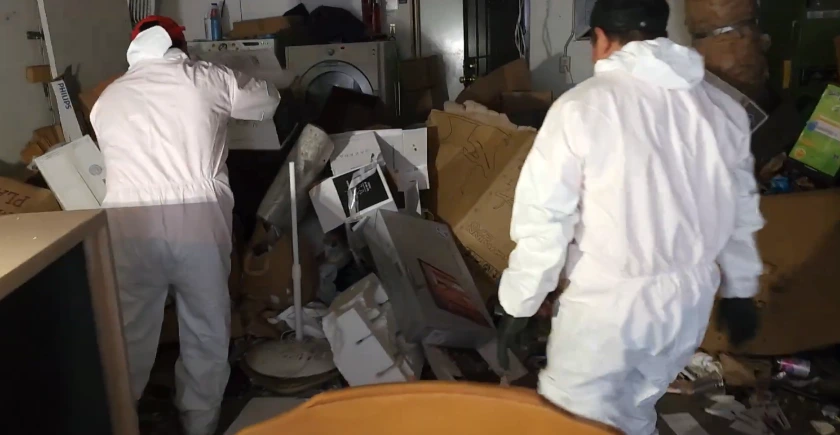
- PPE and containment setup. Technicians don full appropriate PPE — P100 respirators for enclosed spaces, chemical-resistant nitrile gloves, Tyvek suits — before entering a contaminated area. HEPA air filtration equipment is established to maintain negative-pressure airflow in enclosed spaces, preventing contaminated air from migrating to adjacent rooms.
- Removal of porous materials. Carpet, upholstered furniture, drapes, and other porous materials that cannot be reliably decontaminated are removed and disposed of as contaminated waste. Porous surfaces retain fentanyl at higher concentrations than hard surfaces and do not respond consistently to chemical treatment.
- Chemical surface decontamination. Hard surfaces are treated with specialized chemical decontaminants formulated for opioid deactivation and removal. Treatment includes appropriate dwell times on each surface type to ensure efficacy. Standard household and commercial cleaners — including bleach — are not adequate for fentanyl decontamination.
- HEPA vacuuming and air filtration. HEPA-filtered vacuuming of all surfaces captures fine fentanyl particles without re-aerosolizing them. HEPA air scrubbers run throughout the decontamination process and for a defined period after to clear the air. Standard vacuums must not be used — they exhaust fine particles back into the air.
- Post-decontamination wipe sampling. Following decontamination, the technician collects post-remediation surface wipe samples at all previously sampled locations and submits them for laboratory analysis. The property is not released for re-occupancy until clearance results are confirmed.
Landlord & Property Manager Obligations
California imposes real habitability obligations on landlords, and fentanyl contamination at levels that pose a health risk falls within the scope of conditions that render a dwelling uninhabitable under California Civil Code §1941.
- Post-eviction assessment. When a tenant is evicted for cause related to drug use, or leaves with evidence of significant fentanyl use, landlords should consider surface testing before re-tenanting. Placing a new tenant in a contaminated unit without remediation could create liability for habitability violations.
- Post-OD death assessment. When a tenant dies of an overdose in the unit, the property should be treated as a potential contamination site. If fentanyl use was known or evident, surface testing is advisable before re-tenanting — particularly in units with carpeting, upholstered fixtures, or shared HVAC.
- Adjacent unit considerations. In multi-unit buildings with shared HVAC systems, fentanyl can migrate through ductwork. Where contamination testing reveals elevated surface levels, ClearPath assesses HVAC system contamination and adjacent units on request.
- Civil Code §1710.2 disclosure obligations. California requires sellers and, in some circumstances, landlords to disclose known deaths on a property within three years. Where an overdose death is involved, consulting an attorney about disclosure obligations before re-tenanting is advisable.
Estate & Overdose Death Cleanup
When a person dies of a fentanyl overdose, the property often requires both biohazard cleanup for biological material and fentanyl decontamination for surface residue — two related but distinct cleanup scopes.
ClearPath handles both in a single engagement. Our unattended death and overdose response includes:
- Removal and disposal of biological material (blood, bodily fluids) under Cal/OSHA §5193 protocols
- Pre-remediation fentanyl surface sampling to establish contamination scope
- Fentanyl surface decontamination of affected areas
- Post-remediation sampling and laboratory clearance verification
- Itemized documentation suitable for estate administration and probate court submission
- Discreet, unmarked vehicles; discreet scheduling to protect the family's privacy
Families navigating the loss of a loved one to overdose often also deal with probate proceedings, estate sale preparations, and property transitions. ClearPath provides a full clearance documentation package appropriate for each stage — from the initial cleanup through property transfer.
If you are dealing with the sudden loss of a loved one and need guidance on what to do first, call ClearPath. We can help you understand what the cleanup scope involves and walk you through the process at whatever pace you need.
San Francisco's Fentanyl Crisis & Property Risk
San Francisco's overdose death rate from fentanyl is among the highest of any major US city. The Tenderloin, Civic Center, 6th Street corridor, and SoMa account for the highest concentration of outdoor use, but fentanyl is present across nearly every neighborhood through secondary distribution networks.
Property types at elevated risk in SF include:
- Tenderloin SROs — high resident turnover, shared hallways, and limited ventilation increase contamination risk across shared surfaces
- Mission and SoMa apartments — mid-market residential properties with high tenant turnover and OD incidents reported by neighbors or discovered during unit turnovers
- Downtown hotels and motels — particularly along Market Street, 6th Street, and in SoMa, where overnight guests occasionally use in rooms
- Post-encampment properties — commercial properties and parking structures adjacent to or previously occupied by encampments, where fentanyl residue may be present in common areas
The city's SF DPH (Department of Public Health) tracks opioid overdose deaths and coordinates post-overdose community response — but SF DPH does not perform property decontamination. That responsibility falls to the property owner or responsible party.
Service Areas — San Francisco
Fentanyl Cleanup FAQ — San Francisco
Is fentanyl residue on surfaces actually dangerous?
How do you test a property for fentanyl contamination?
How long does fentanyl remain active on surfaces?
Is a landlord required to disclose fentanyl contamination to new tenants?
Can you clean fentanyl contamination from a vehicle?
Fentanyl Testing & Decontamination in San Francisco
Invisible contamination, lab-verified clearance. ClearPath responds within 2 hours, anywhere in San Francisco — 24/7, 365 days a year.
(628) 202-8803 Get Free Quote